Document Type : Original Article
Authors
1
Department of Law, Faculty of Literature and Humanities, Islamic Azad University, Yazd Branch, Yazd City, Iran.
2
Department of Political Science, Faculty of Law and Political Science, Yazd University, Yazd, Iran.
3
Department of Law, Faculty of Administrative Sciences and Economics, Isfahan University, Isfahan, Iran.
Abstract
In the Islamic Republic of Iran, public rights are considered the cornerstone of social justice and the guarantor of fundamental freedoms for citizens. Articles 23, 29, and 159 of the Constitution also emphasize legitimate freedoms and human dignity as the axis of all laws. The judiciary, according to Article 156, Clause 2 of the Constitution, is obliged to make every effort to combat attacks on public rights and freedoms and to remedy the shortcomings of itself and the other branches of government. This is because the judiciary has mechanisms at its disposal to achieve this, but despite the Judicial Transformation Document, which is designed to remove obstacles, these mechanisms sometimes face challenges. The problems that need to be addressed seem urgent in order to preserve the order and authority of the judiciary and the Islamic Republic system.This research seeks to answer the main question of what are the fundamental obstacles and challenges facing the judiciary in upholding public rights?
The main obstacles facing the judiciary include ambiguity in the definition of public rights, the lack of ordinary laws, and the lack of a designated oversight body. To address these challenges, measures such as structural reforms and changes in judicial oversight, control of a pluralistic society, and the promotion of formal and informal institutions under the judiciary, including the prosecutor's office, the Inspector General's Office, and the Human Rights Headquarters, are proposed. These measures can significantly improve the development of public rights; therefore, Article 8 of the Constitution should be given careful attention and a special working group should be established to implement it. The research method is descriptive-analytical.
Keywords
Subjects
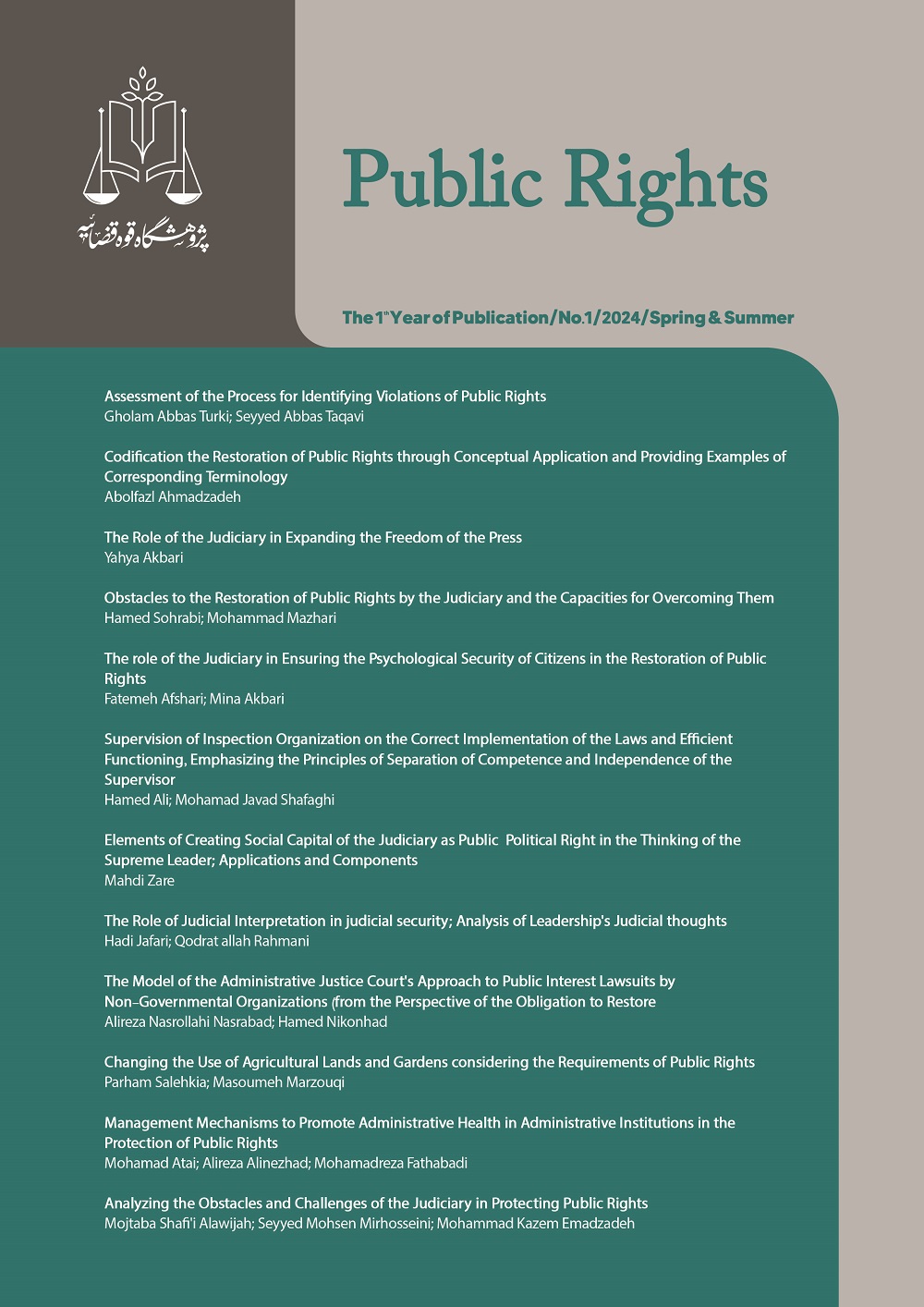
 Public Rights